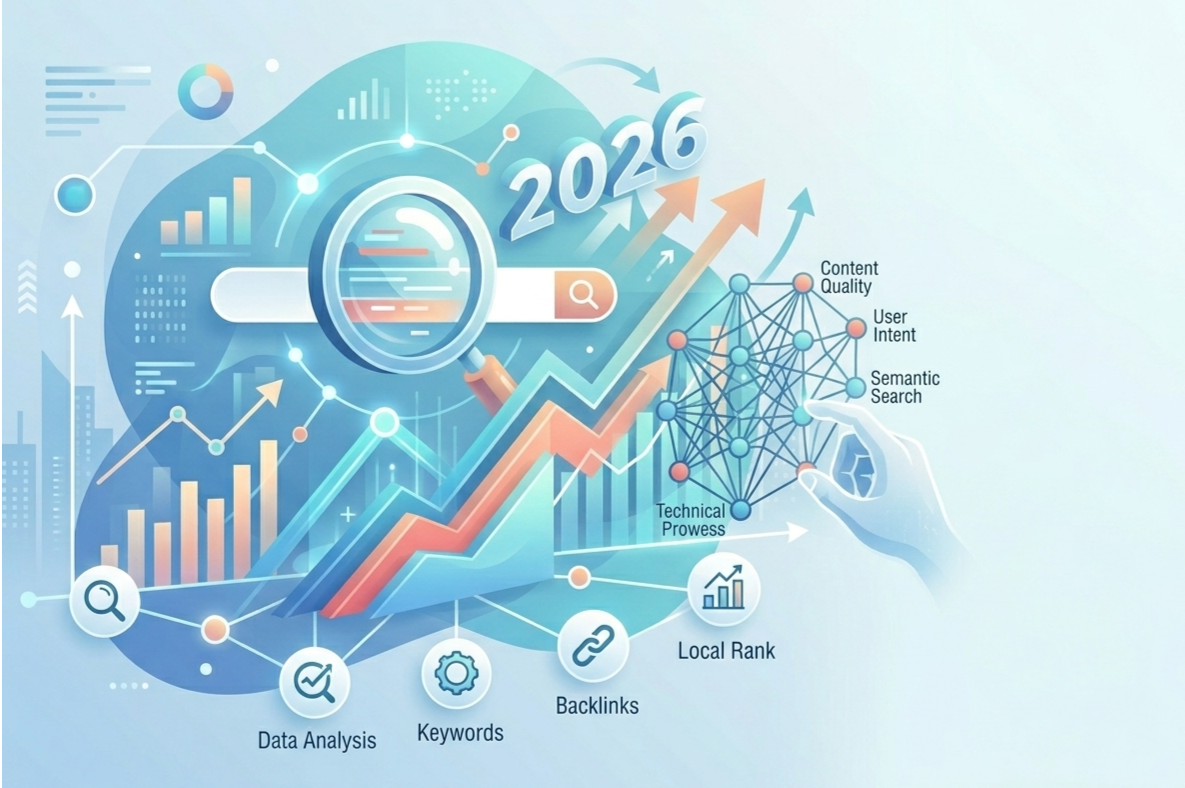
SEO stands for Search Engine Optimisation, but today it means much more than just ranking on Google. SEO in 2026 has grown into “Search Everywhere Optimisation,” meaning your brand needs to be visible not only on search engines but also on AI tools and social platforms like TikTok and YouTube.
The focus is now on building strong brand authority, delivering a smooth user experience, and earning real trust. It still matters because it brings steady organic traffic, improves credibility, and makes sure your content can be found and understood by both AI systems and real people.
Search Engine Optimisation is not a shortcut or a one-time fix. It’s more like building a solid foundation for a house. You plan carefully, lay each brick properly, and strengthen the structure over time. In the same way, SEO is a structured process that helps search engines clearly understand your website and determine when it is relevant enough to present to users.
Search Engine Optimisation helps your website rank higher in search results by matching your content with what people are searching for and what search engines expect to see. It focuses on three key areas: On-page SEO, Off-page SEO and Technical SEO.
Modern SEO also places strong importance on E-E-A-T (Experience, Expertise, Authoritativeness and Trustworthiness), clear topic signals, and creating content that truly matches user intent.
Difference between SEO and Paid Ads
Search Engine Optimisation is about growing your website’s traffic naturally over time by improving it so search engines trust and rank it higher. Paid ads or PPC give you quick visibility, but you only appear while you are paying for the advert.
SEO costs less in the long run and helps build real trust with your audience. By focusing on E-E-A-T principles, SEO fosters genuine connections that paid ads often struggle to replicate without sustained effort.
Paid ads are useful when you need fast results, such as promoting a special offer or launching a new product.
When Should One Choose SEO or Paid Ads (PPC)?
SEO: Best for building strong authority, steady traffic, and better returns over time.
Paid Ads (PPC): Best for quick visibility, short campaigns, or promoting a new product fast.
Using both together often works best, giving you steady long-term growth while also bringing quick results when you need them.
Breaking Down How SEO Works
Search Engine Optimisation works as a simple step-by-step process that you keep improving over time. It includes checking your website, finding the right keywords, fixing technical issues, creating helpful content, and earning trusted links. You also review competitors, improve titles and headings, make sure the site works well on mobiles, and track results using analytics.
SEO helps search engines find, understand and rank your pages based on how useful and trustworthy they are. It improves your visibility by using clear keywords, quality backlinks and strong technical setup.
Crawl - Search bots find your pages.
Index - They read and store your content.
Rank - They decide where your page appears based on relevance, trust and quality.
The Three Pillars of SEO
The three main parts of SEO are Technical, On-Page and Off-Page. All these three are the base of good search rankings. Together, they help search engines find your website, understand your content, and trust it enough to show it to users. When these three areas work well, your site gets more organic traffic and gives visitors a better experience.
1. Technical SEO (The Foundation)
This makes sure search engines can properly read and store your website. Making sure your site is fast, mobile-friendly, easy to crawl and well organised.
- Site Speed: Pages load quickly.
-
Mobile-Friendly: Works well on phones and tablets.
- Security (HTTPS): Safe and secure browsing.
-
Crawling & Indexing: They ensure search bots can move through your website correctly.
2. On-Page SEO (Making Content Clear and Useful)
This improves what people see on each page. Improving your content, headings, keywords and page structure so it is clear, relevant and helpful.
-
Keyword Use: Using the right search terms.
-
Quality Content: Helpful and well-written information.
-
Meta Tags: Clear titles and descriptions.
-
Internal Links: Linking pages together clearly.
3. Off-Page SEO (Building Trust and Reputation)
This shows search engines your site is trusted. Strengthening your website’s reputation through quality backlinks and positive online mentions.
-
Backlinks: Links from strong, relevant websites.
-
Social Engagement: Activity on social platforms.
-
Brand Mentions: People talking about your business online.
Why They Matter Together
A strong SEO strategy works best when all three areas work together. Technical SEO makes sure your website can be found and accessed easily. On-Page SEO improves your content so it matches what users are searching for. Off-Page SEO builds trust and authority. If you ignore one of these, your overall results can suffer, no matter how well you manage the others.
How long does SEO take?
Realistic Timelines
SEO usually takes 3 to 6 months to show clear early results. Noticeable growth often takes around 6 to 12 months. It is a long-term strategy that builds steady growth over time, not a quick fix.
Factors Affecting Results
Results depend on your website’s health, the quality of your content, your SEO strategy, and how consistently you improve your site. Regular updates and strong optimisation help speed things up.
Industry Competition
If many businesses are competing for the same keywords, it will take longer to rank. Less competitive niches often see faster results.
Domain Authority
Older websites with a strong reputation and good backlinks usually rank faster than brand-new websites.
Content Velocity
Websites that publish helpful, high-quality content consistently tend to grow faster than those that update rarely.
We should always remember that SEO is not a quick fix. It is a long-term strategy that builds results step by step over time.
Common SEO Mistakes to Avoid
Many SEO problems happen because of simple mistakes. These include writing poor or copied content, using too many keywords, ignoring mobile users, having slow pages, and not checking results with analytics. Other common issues are weak internal links, missing titles and descriptions, skipping local SEO, and not optimising images properly.
Top SEO Mistakes to Avoid
Content & Keyword Mistakes
- Writing thin or unhelpful content that does not answer real questions.
- Stuffing too many keywords into a page.
- Copying content across different pages.
- Choosing keywords without understanding what users really want.
Technical SEO Mistakes
- Slow loading pages due to large images or heavy code.
- A site that is not mobile-friendly.
- Broken links or missing images.
- Not using HTTPS security.
- Incorrect use of structured data.
On-Page & Structure Mistakes
- Missing clear page titles and meta descriptions.
- Poor internal linking that makes navigation confusing.
- Not adding alt text to images.
Strategy Mistakes
- Ignoring local SEO and Google Business Profile updates.
- Not tracking results in Analytics or Search Console.
- Using outdated or risky SEO tactics.
How to Measure SEO Success
To know if your SEO is working, you need to track the right results. Here are the key things to measure:
Organic Traffic
Check how many people visit your website through unpaid search results. If this number is growing, your SEO is improving.
Keyword Rankings
Monitor where your website appears in search results for your target keywords. Higher rankings usually mean better visibility.
CTR (Click-Through Rate)
This shows how many people click your website after seeing it in search results. A higher CTR proves your titles and meta descriptions are engaging.
Conversion Rate
Track how many visitors take action, such as filling in a form, calling your business, or making a purchase. Traffic is good, but conversions matter most.
SEO Tools to Track Performance
- Google Analytics - Measures traffic, user behaviour, and conversions.
- Google Search Console - Shows keyword performance, impressions, clicks, and technical issues.
- SEMrush - Tracks rankings, backlinks, and competitor performance.
By reviewing these regularly, you can see what is working, what needs improving, and how your SEO efforts are growing over time.
Future of SEO in 2026
SEO is changing quickly as technology improves and user behaviour evolves. These trends are defining the future of SEO:
AI-Driven Search
Search engines now use advanced AI to better understand context, meaning and user intent. Content must be clear, helpful and trustworthy to perform well.
Entity-Based Search
Instead of only focusing on keywords, search engines understand topics, brands and people as “entities.” Building strong brand signals and clear subject relevance is becoming more important.
Voice Search Optimisation
With more people using voice assistants, content should sound natural and answer questions clearly, just like a real conversation.
Search Generative Experience (SGE)
AI-powered search results provide direct answers and summaries. Websites need high-quality, structured content to be included in these AI responses.
Topical Authority Over Keyword Density
Search engines now prefer websites that show deep knowledge on a subject rather than pages that simply repeat keywords. Creating detailed, well-connected content around a topic builds long-term authority.
Why SEO Is a Long-Term Growth Strategy
SEO helps your business grow steadily over time. Unlike paid ads that stop when you stop paying, SEO keeps bringing visitors naturally. The work you do today can continue to give results for months or even years. Internal linking evolves with your content updates, creating lasting pathways that sustain traffic flow and improve site longevity.
It also builds trust. When your website appears high in search results, people see your brand as trustworthy and professional. SEO attracts users who are already looking for your services, which means better quality leads.
Results may take time, but SEO creates a strong foundation for long-term, sustainable growth.
Importance of SEO That No One Should Ignore in 2026
In 2026, having a website is not enough. If people cannot find you online, they will find your competitors instead. SEO helps your business stay visible, trusted and easy to discover on search engines and AI platforms. Even internal linking should be strategic to avoid user frustration and ensure search engines understand the hierarchy of your site's pages.
That is why SEO is more important than ever for long-term growth.
Keeps Your Business Visible
SEO helps your website appear on Google and AI search tools, so customers can find you easily.
Builds Trust and Credibility
Higher search rankings make your brand look reliable and professional.
Brings Free Organic Traffic
Unlike paid ads, SEO continues to bring visitors without ongoing ad spend.
Attracts the Right Customers
Search engine optimisation targets people who are already looking for your services.
Supports Long-Term Growth
SEO is a long-term strategy that helps your business grow steadily and stay ahead of competitors.
Ignoring SEO today means missing opportunities tomorrow.
Ready to Grow with SEO? Partner with V1 Technologies
If you want real business growth, SEO is the smart place to start. At V1 Technologies, we use clear strategy, strong technical skills, and over 14 years of experience to help businesses grow online. We have completed 2,000+ projects for more than 1,500 clients, delivering websites and mobile apps that are built to perform.
Our approach is simple, we create fast, user-friendly, and search-optimised digital solutions that attract the right audience and turn visitors into customers. Whether you need better rankings, more traffic, or a powerful mobile app to support your growth, our team is here to help.
We help your website grow the right way. First, we check on site SEO to make sure your pages are clear, fast, and easy to read. We fix titles, headings, and Internal Linking so Google understands your site better.
We improve your Keyword Rankings by using the right words that people search for. Then we track results in Google Search Console to see clicks, views, and problems. This helps us make smart changes that bring better results. At V1 Technologies, we use AI-Driven Search to help your website get noticed.
We check on site SEO and fix speed, content, and links so search engines understand your site easily.
We build topical authority by creating strong and helpful content around your main topic.
We focus on E-E-A-T so your website shows real experience, knowledge, trust, and authority. We also use entity-based search so Google understands your brand, not just your keywords
As your traffic grows, we work on your conversion rate. We turn visitors into real customers with clear messages and simple actions. We also build your domain authority by earning strong, trusted links.
Let’s build something that grows your business for the long term.
FAQS
Why Is SEO Seen as a Long-Term Strategy?
Answer:
SEO takes time because trust and authority are built step by step. Search engines need time to understand your website and rank it higher. The work you do today can keep bringing traffic for months or even years.
Is SEO a Long-Term Investment?
Answer:
Yes, SEO is a long-term investment. It may take a few months to show strong results, but it gives steady traffic without paying for ads every day. Gradually, it turns into a budget friendly and lasting solution.
What Are the Four Main Pillars of SEO?
Answer:
The four main pillars of SEO are:
- Technical SEO - Making your site fast, secure and easy to crawl.
- On-Page SEO - Improving content and page structure.
- Off-Page SEO - Earning credibility and strengthening reputation with backlinks and brand mentions.
- Content - Creating helpful, high-quality information for users.
Does SEO Still Matter in 2026?
Answer:
Yes, SEO still matters in 2026. People continue to use search engines and AI tools to find information, products and services. Good SEO helps your business stay visible, trusted and easy to find online.