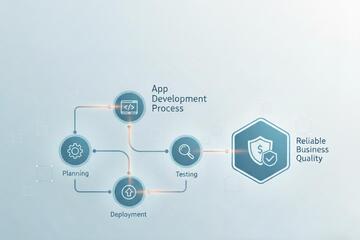
In a world where smartphone use continues to grow, and where customers expect seamless digital experiences at their fingertips, app development has moved from “nice to have” to essential. Whether you are launching a new venture, expanding your business, or modernising how customers engage with your services, a well-designed app can create a real competitive advantage. This is not only because an app can deliver convenience to your users, but because it represents a strategic asset that can help you scale, engage, and adapt to evolving market demands. In this article, we examine app development from a holistic viewpoint: what makes good app development, why it matters, and how businesses can leverage it to build trust, deliver value, and stay ahead in a crowded digital environment.
We draw on the values and standards of providers such as the team behind V1 Technologies to illustrate how careful planning, technical excellence, user-centred design, and long-term support can make the difference between an app that simply exists and an app that actually works and grows with your business.
Why App Development Is More Than Just Code
Many people associate app development with writing lines of code and deploying to a store. But real, quality app development involves much more. At its core, it is about solving real user problems, delivering a reliable experience, and building trust — not only with users but with your own brand’s future. When done well, an app becomes a bridge between your business and its customers, offering a direct, engaging channel that can drive growth, loyalty and operational efficiency.
A quality app begins with a clear vision of what the end user needs. That involves careful ideation, understanding user behaviour and business goals, and mapping out an experience that delivers value. Good app development also means thinking ahead: scalability, performance, security, maintainability. Without these, you end up with an app that may work at first but fails under load, gains bad reviews, or becomes costly to update.
Furthermore, an app should be platform-appropriate. Native development for iOS or Android delivers high performance and deep integration with device features. Cross-platform solutions allow cost-effective reach across many devices while maintaining consistency. The best providers combine technical skill, creative design, and user-centric thinking to ensure the app not only works but delights.
This holistic view lies at the heart of professional app development agencies. By combining creativity and technical skill, these companies can transform an abstract idea into a reliable, polished product — an asset that grows with your business and continues to deliver value over time.
What True Quality in App Development Looks Like
When you consider hiring app developers or embarking on your own development project, it helps to know what distinguishes a well-executed app from a mediocre one. Several key elements define real quality: clear planning, technical excellence, user-centred design, cross-platform strategy when needed, performance optimisation, security, and ongoing support.
Professional app developers begin with careful analysis and planning. That includes understanding the core purpose of the app, defining requirements, selecting the right technologies, and anticipating future growth. Good planning helps avoid common pitfalls like scope creep, inconsistent performance, or poor user experience. Once planning is complete, building the app calls for skilled developers who know the specificities of each platform — for instance, knowing how iOS differs from Android in terms of UI style, performance expectations and app store requirements — and designers who ensure that the user interface and user experience feel intuitive, modern, and relevant.
If the goal is to target multiple platforms (iOS and Android), cross-platform frameworks might be used to reduce cost and development time, while still preserving quality. The right choice depends on the app’s purpose, expected user base, and long-term goals. Whichever path is chosen, the final product must be responsive, fast, secure, and stable.
After launch, maintenance and support are often overlooked. Yet they matter, especially when technology changes, user needs evolve, or scaling becomes necessary. Post-launch support ensures bugs are fixed, new features can be added, performance stays sharp, and security is maintained. Without long-term maintenance, even a good app can degrade over time.
Key Considerations When Building an App
When you think about building an app, whether for customers or internal business operations, certain crucial considerations should guide your decisions. First is clarity about purpose: What problem are you solving? Who are the users? What tasks should the app solve better than a website, email or other channel? Having clarity on these questions ensures that development, design and user experience decisions remain focused and effective.
Second is choice of platform and development style. Native apps (iOS or Android) are ideal when you need deep device integration, high performance, or compliance with platform-specific guidelines. Cross-platform frameworks allow you to reach users across devices with a shared codebase, speeding up development and reducing cost. The decision must balance the needs of your audience, project complexity, budget and long-term maintainability.
Third is user experience. An app should feel natural, intuitive and rewarding to use. That means smooth navigation, thoughtful design, responsive performance, and quick load times. Slowness or bugs can lead to user frustration and abandonment. A great design does not only look good: it builds trust and invites users to return.
Fourth is scalability and architecture. Even at early stages, an app should be built with growth in mind. Choosing scalable frameworks, efficient backend solutions, and solid coding standards ensures that as your user base grows, the app remains stable and performant. Security must also be baked into the architecture: user data, authentication, encryption — everything needs to be secure from the ground up.
Finally, there is maintenance and evolution. Technology moves fast. User expectations change. Your app needs to be updated and improved regularly. That requires documentation, version control, monitoring, bug-fixes and clear update strategies. Without ongoing maintenance, an app risks becoming obsolete or insecure.
How App Development Delivers Value Back to Business
A well-developed app is not just a product: it becomes a strategic asset. First, it strengthens your relationship with customers. With a dedicated app, you control the experience: you decide how users interact, what they see, how they receive notifications, how they transact. This direct channel helps build loyalty and brand value.
Second, an app can streamline business operations. Internal apps can automate tasks, enable staff to work efficiently, centralise data, and improve coordination. Whether you are a startup, a small business or a large enterprise, an app can boost productivity, reduce errors, and improve service delivery.
Third, an app can open new revenue streams. Through e-commerce integration, subscription models, in-app purchases or service bookings, an app can provide opportunities not available via traditional channels.
Fourth, in saturated markets, having a polished app can be a differentiator. Users often judge credibility and professionalism by how smooth and modern a brand’s digital presence feels. An app that feels reliable and well-designed gives a strong impression of quality and commitment.
Lastly, a well-built app is easier to maintain and evolve. Because it is designed with architecture, scalability and maintainability in mind, future updates and expansions are manageable. This reduces long-term cost and risk.
How to Choose the Right Approach and Partner for Your App
Choosing how to build your app and who to build it with matters a lot. If you go for native development, you may benefit from performance, deep integration and compliance with store guidelines. If instead you go for cross-platform, you may benefit from cost-effectiveness, faster time to market and consistent experience across devices. The right choice depends on your needs, user base and long-term vision.
When evaluating partners, look for those who emphasise more than just coding. Seek teams that combine technical skill with user-centred design sensibility, and who offer end-to-end services: from planning and prototyping to development, testing, launch, and post-launch support. Transparency in cost and process, clear communication, and flexibility are also important. The ideal provider demonstrates experience across many projects, adapts to different industries, and can offer scalable, secure, maintainable solutions.
Trust comes from track record. A provider with many successfully delivered projects, experience across platforms, and a clear process for quality assurance and maintenance is likely to deliver more reliable results.
Final Thoughts
App development is not a short-term task. It is a long-term commitment. When you understand that building an app is about creating value — for users, for your business, for your brand — you set the stage for something that can grow, adapt, and thrive.
Whether you are launching a new product or service, improving internal workflows, or giving your customers a modern way to engage, investing in quality app development can pay dividends. By combining thoughtful planning, technical expertise, user-centred design, and ongoing support, you can create an app that does more than just exist: it becomes a meaningful part of your business.
If you are exploring the idea of building an app, take your time. Define your goals clearly. Think about users first. Consider the right platforms and development approach. And choose a partner who understands that success is not just about launching an app — it is about building something that lasts.